“If you become a regular, you meet other people, you talk to other people, suddenly you can also discover a different way of relating to what the university is as a community.”
On a Wednesday in April, the Sydney, Australia-based author and translator Tiffany Tsao sat in on Professor Sasha Senderovich’s class on contemporary global literature to discuss her novel, The Majesties. As students formed an impromptu line to request her signature inside their personal copies, one commented that he had never had a book signed by an author before. This was an eye-opening moment for Senderovich. Whole parts of literary and intellectual communities in Seattle existed that his undergraduate students had not been exposed to or were unaware they could access. He followed up with an invitation for later that evening: Tiffany Tsao in conversation with editor Gabriella Page-Fort at Elliott Bay Book Company in Capitol Hill. Several of his students attended, some remarking that they hadn’t previously known that bookstores host free opportunities for the public to meet and hear from authors.
Tiffany Tsao, an award-winning translator of Indonesian literature and an author herself, was visiting the University of Washington for the third annual Literary Translator Residency. This program, sponsored by the UW Translation Studies Hub, with funding from UW alumna Lee Scheingold and support from the Simpson Center, hosts an internationally known translator during Spring quarter for a series of events on and off campus. Anton Hur, who translates from Korean, was the inaugural visit in 2024; Sawad Hussain, who translates from Arabic, followed in 2025. Sasha Senderovich (Associate Professor, Jackson School of International Studies and Slavic Languages & Literatures), one of the organizers of the program, explains that featuring a translator as a visiting scholar is one way that the Translation Studies Hub showcases how much we engage with translations at the University, something we often take for granted.
In Tsao’s public lecture, attended by 110 people, she advocated for approaching fiction written in Indonesian and other non-Western languages as complex literary works rather than simple reflections of exotic cultures. She argued that Indonesian books and authors should be valued for their form and style, and ability to speak to broader human experiences. Tsao also advocated for the importance of translated literature. “If we keep stories in boxes, if we prize them primarily for being of X country’s make [or] Y country’s origin and we never open the boxes [to] read the stories for themselves, and let the writers who wrote them touch us on an emotional [or] personal level through those stories, I don’t think we’ll ever be able to appreciate, to connect with, to digest, to internalize these stories for [what] they really are.”
During the Q&A following Tsao’s lecture, all but one of the questions were asked by students, something that Senderovich remarks “was really unusual for a university event.” Undergraduate students were present throughout the week, along with a mix of faculty, graduate students, and staff we often see at Simpson Center gatherings. As with previous years, the events tied to Tsao’s residency also drew Seattle-based translators and writers, as well as people with an interest in books and literature who may be new to discussions of the art of translation. According to Senderovich, “you have someone present, in a very intense concentrated way, for most of a week. You create a community for the week. And then you sustain it into the next year, and then from year to year.”
Senderovich, as a co-lead of the UW Translation Studies Hub, works intentionally to build this audience and create a web of connections permeating the university in the lead-up to the weeklong residency. He coordinates with colleagues about the kinds of events to host and the ways to reach people. He partners with local bookstores to promote the work of the resident. He thinks about curriculum and encourages fellow professors to incorporate an essay or book by the translator into their syllabi. Alongside enhancing translation literacy through his own research and pedagogy, he is also a skilled connector whose efforts help generate interest, cultivate an invested audience, and build community.
When asked about a highlight from the week, Senderovich harkened back to the moment in his class when he realized how transformative this kind of programming and exposure can be for students. “I want the events we plan to be more accessible to more of our students… We have students who are interested who often don’t really know what the possibilities are unless you invite them in. And suddenly they know that ‘oh my god you can meet people who translate books and write books’.”
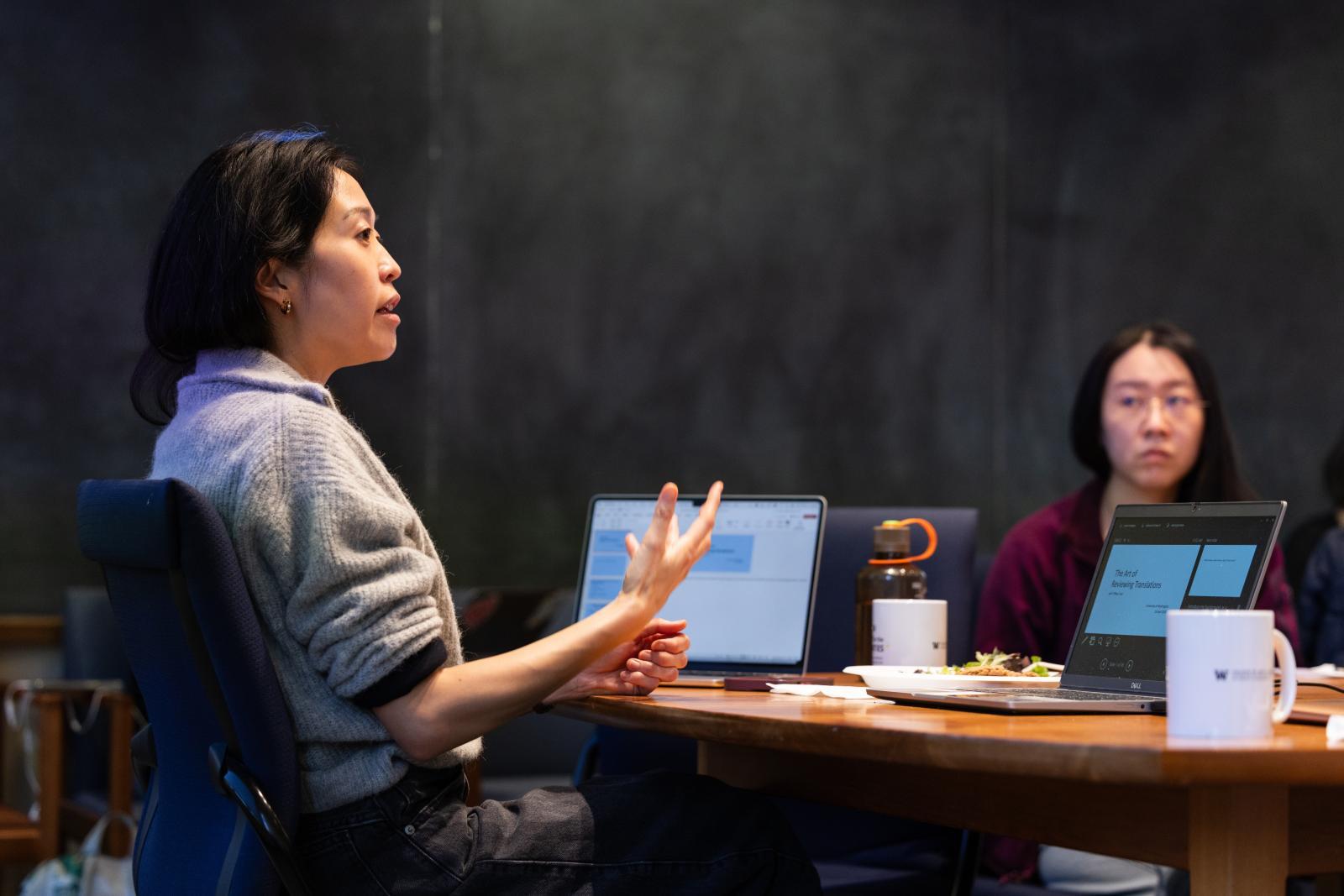
It is fitting, then, that the week closed with a conversation rooted in student learning and connection. Over breakfast on Friday, Tsao led a discussion about her translation of, Norman Erikson Pasaribu’s short story collection, Happy Stories, Mostly. Around the table sat undergraduate students and some PhD candidates representing fields like English, Asian Languages & Literatures, Cinema & Media Studies, Biochemistry, and Engineering. Participants, who were gifted the book in advance, asked Tsao about word play and humor, about when she decides to leave parts of the writing in the original language, and which stories were the hardest to translate. They also wanted to know whether she fusses over every single sentence. (Her answer was “yes.”) My sense, though, was that these students gained far more from the conversation than knowledge about the nuts and bolts of literary translation. Senderovich agreed. “They were learning…that there are so many aspects to rich intellectual life.”
After the breakfast, one student asked Senderovich “how often do you do this?” The answer was once per year but Senderovich senses from students a hunger for more in-person intellectual exchange outside of formal classes, something he’s committed to cultivating. “If you become a regular, you meet other people, you talk to other people, suddenly you can also discover a different way of relating to what the university is as a community.” Being in such community, he explains, feels “magical,” like getting lost in a good piece of translated literature.