"SIAH is designed to develop undergraduate students as researchers in their own right. The course provides students with the time and space to innovate and to determine, as Cook put it, “How do I ask good questions?”
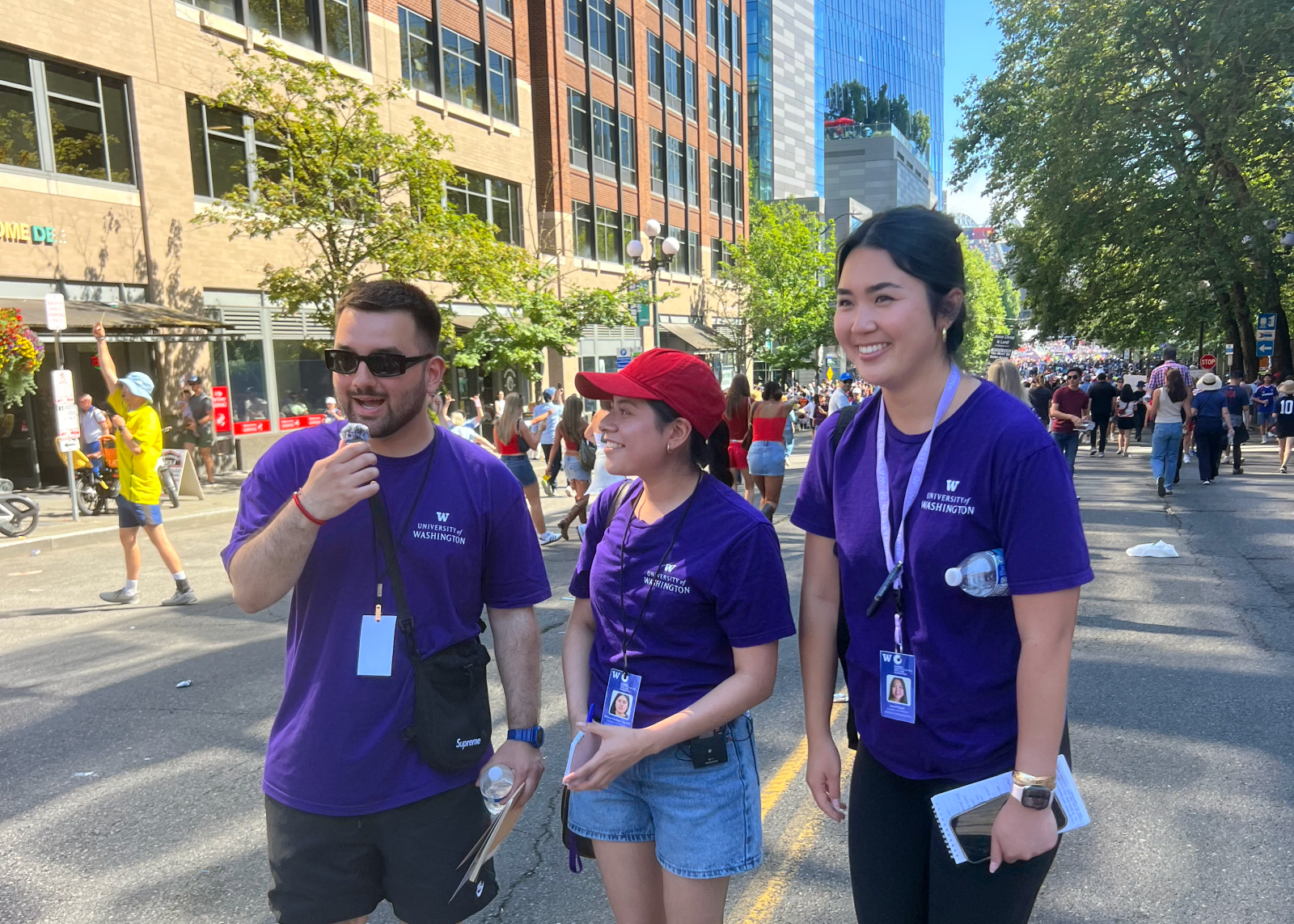
On one of the busiest days in the history of downtown Seattle, three University of Washington undergraduate students stood quietly in Pioneer Square, scribbling in their notebooks as they observed crowds of soccer fans adorned in red, white, and blue. They had alighted at the International District light rail station around 1:00 pm to begin their six hours of fieldwork before kickoff for the United States vs. Belgium game at Lumen Field. It was the final 2026 FIFA World Cup game that would be hosted in Seattle and also the final day of fieldwork for their summer course.
Their course — the 2026 Summer Institute in the Arts and Humanities (SIAH) — enlisted 19 students to study the tournament's impact on Seattle and, in turn, visitors' experiences of the city. Students, working in small teams, conducted research downtown on four of the six Seattle game days. As they plied the streets around the stadium, Pioneer Square, and the Waterfront, they alternated between jotting down observations, recording interviews, and eliciting survey responses. Students strategized in real time about who to approach and teamed up to ask questions, manage their audio recording equipment, and take notes. Their interviewees ranged from a street vendor and transit volunteers to people protesting ICE and soccer super fans, like the father and son who had handmade their matching jerseys by cutting and sewing together a USA and Mexico jersey, celebrating dual affinities. Students encouraged each other when one was more tentative than another and they leaned into their various strengths, including conducting non-English interviews– which turned out to be common on their research outings.
SIAH is a course supported by the Office of Undergraduate Academic Affairs, the Office of Undergraduate Research, the Office of Research, the Simpson Center for the Humanities, and the Mary Gates Endowment. It brings together students from across the university each summer to conduct research around a particular theme. This summer’s course, “Seattle’s World Cup: Storytelling Through Community Mapping,” engaged students majoring in Political Science, Journalism, Psychology, Biochemistry, Art, Mathematics, Computer Science, History, and more to develop collaborative research projects.
Each year, the SIAH curriculum is developed by a different teaching team around an entirely new topic. Caley Cook, a teaching professor in the Department of Communication, who co-taught with Ron Krabill, professor of Interdisciplinary Arts & Sciences at UW Bothell and director of the UW Global Sports Lab, and Yasir Zaidan, a PhD Candidate in the Jackson School of International Studies, describes the group as “three of the biggest soccer fans on the planet.” They welcomed the world coming to their city for soccer and relished the opportunity to create a once-in-a-lifetime research experience for undergraduate students.
Cook explains that their teaching team – made up of a journalist, a sociologist, and an international policy researcher – fostered an interdisciplinary approach that was incredibly unique in her 25 years of teaching. They pushed one another to combine methods and concepts in ways not normally done in academia. Krabill agrees, “my experience has been anytime you do research in an interdisciplinary setting, you run up against all kinds of assumptions in terms of how people have been trained about what research means, what knowledge means, how you acquire it…One thing that's exciting about SIAH is bringing students together across those boundaries, but also faculty.”
The timing of the World Cup necessitated flexibility in the course structure. On days one and two of class, students were introduced to research methods, to critical sports studies as a field, and to each other. On day three, they spent six hours in the field. Krabill said of the timeline, “it was like zero to 60 in half a second.” He also explained how the research they did had to be more iterative as a result. “Students [were] forced into a very different mode of research that arts and humanities are particularly suited to meet in a powerful way.”
Zaidan, who submitted his dissertation just last month shared that, in his experience, research almost always requires retooling. As a qualitative social scientist, he is used to starting with a research question and creating a proposal before going into the field. However, he says that “when you go into the field, it’s a different world. And then you come back, and you kind of change the whole proposal and change the whole question.” The nature of this course gave students a chance to learn that "the field" can be quite different from what they envision or propose to explore when sitting in a classroom. To counter the immediate intensity of the course, the teaching team built in flexibility across the ten weeks. This approach, Cook explains, fostered creativity and resilience:
“I cannot overstate the value for students to really take a lead in research early in their careers… you can see students opening up a view of the academic world, industry, methodologies that they would never have had a concept of…There's something about a research-based class when there's not someone telling you, this is what you have to do, and this is how you have to do it, and this is the form it's going to take.”
SIAH is designed to develop undergraduate students as researchers in their own right. The course provides students with the time and space to innovate and to determine, as Cook put it, “How do I ask good questions?”
On the day of the United States vs. Belgium game, over a quick meal in the International District, the students told me what was next, now that the fieldwork portion of their course was ending. They would return to the classroom and begin piecing together their notes and interviews into final projects that could tell a story about how people experienced Seattle's World Cup. They would form new groups for those projects based on the topics they were interested in pursuing. They would conduct literature reviews, explore the breadth of library resources available to them, gather any additional research or data needed to answer research questions, and determine the best medium through which to convey their findings.
The students shared these findings at the SIAH symposium, a public event on the final day of the quarter. Cook, who as a journalist thinks intentionally about audiences, enjoyed watching the students develop presentation strategies for the symposium and taking steps to put themselves out there. Presenting publicly, Cook believes, changes the research outcomes students produce.
At the day-long symposium, five groups of three to four students presented to a room full of faculty, staff, deans, alumni, and community members, as well as friends and family. They explored topics including diaspora and immigrant identity, forms of protest, FIFA and US foreign policy, and the use of flags, jerseys, and rituals to express fan identity and belonging. The final deliverables included photo and video essays, a zine, a research paper, a hand-stitched soccer ball, and several websites and short documentary films. Each group talked about their research process and limitations, often with a level of self-awareness that included recognition of their own privilege and biases.
One group used the format of Saturday Night Live’s “Weekend Update” sketch comedy to present findings about how US federal travel and immigration policy impacted Seattle’s preparation for and hosting of the World Cup. They explored how Seattle’s status as a sanctuary city influenced this relationship, compared policy during the World Cup with that of major world sporting events from past decades, and explained how media coverage of immigration enforcement decreased significantly during the tournament, while actual enforcement did not. After their presentation, Krabill noted to the crowd that, as someone who has been studying and teaching soccer for decades, their satirical account of Seattle entering a “prenup" with FIFA was the best description that he had heard of cities signing away much of their autonomy in order to host World Cup matches.
Another group analyzed the use of flags, jerseys, ritual, and costumery through the lens of three theoretical frameworks: performative theory, social identity theory, and symbolic interactionism. They presented how physical symbols often associated with sports fandom create an active dialogue about allegiance and identity and how they influence social categorization. In their project outcome–a website and photo essays–they encouraged viewers to draw their own conclusions about the meanings of fan affiliations. Members of the group emphasized the value of learning about and applying theoretical frameworks, a lesson they will take into future projects.
Students had to show vulnerability and step out of their comfort zones early and late in this program in ways that may sound objectively scary. In weeks one and two, they repeatedly walked up to strangers and asked for interviews. In week ten, they stood at a podium, in some cases for the first time outside of a classroom setting, to share research findings with a public audience. The hardest work, though, often came during the slow and quiet grind that happened in between. Cook says that SIAH gives students the space to “really try at something, be challenged by it, struggle with it, and come out the other side... That's truly how you build confidence.”