"On one hand, this project delves into the punitive practices of surveillance, extraction, and harassment that have long been tested out on Black people and others and are now more widely prevalent. On the other, it explores how the same people have resisted those practices."
"Black Digital Studies in the Age of Technofascism" emerged as a crossdisciplinary research cluster intent on exploring the relationship between race and technology. In the era of AI bias, attacks on DEI, and enormously powerful tech companies, their work asks two primary questions. First, what does it mean to be Black when engaging with digital technologies whose design and distribution is shaped by rising authoritarianism and ongoing racial injustice? And, second, what can be learned from the ways that Black people and communities have resisted these technologies?
The project, funded by the Simpson Center for the 2025-26 academic year, began from the recognition that scholars do Black Digital Studies research across a wide range of disciplines and often remain siloed from one another. Led by four University of Washington faculty members—LaShawnDa Pittman (American Ethnic Studies), Chrystel Oloukoï (Geography), Jelani Ince (Sociology), and Golden Owens (Cinema & Media Studies)—the project seeks to understand, from different disciplinary perspectives, how Black people are operating in digital spaces. The team seeks to draw students, faculty, and community members into conversation on this issue.
Like many of the faculty-led projects supported by the Simpson Center, Black Digital Studies has multiple components. In winter, the team co-hosted Professor Tonia Sutherland (UCLA) who delivered the Simpson Center's 2026 Digital Humanities Lecture, “Resurrecting the Black Body: Race and the Digital Afterlife.” In this talk about her book by the same name, Sutherland presented examples of how antiblackness in digital spaces continues after a person dies. She also described how providing broad access to digitized historical photographs and other artifacts, with examples from the era of U.S. racial slavery through to the present, can be problematic for legal, political, and moral reasons.
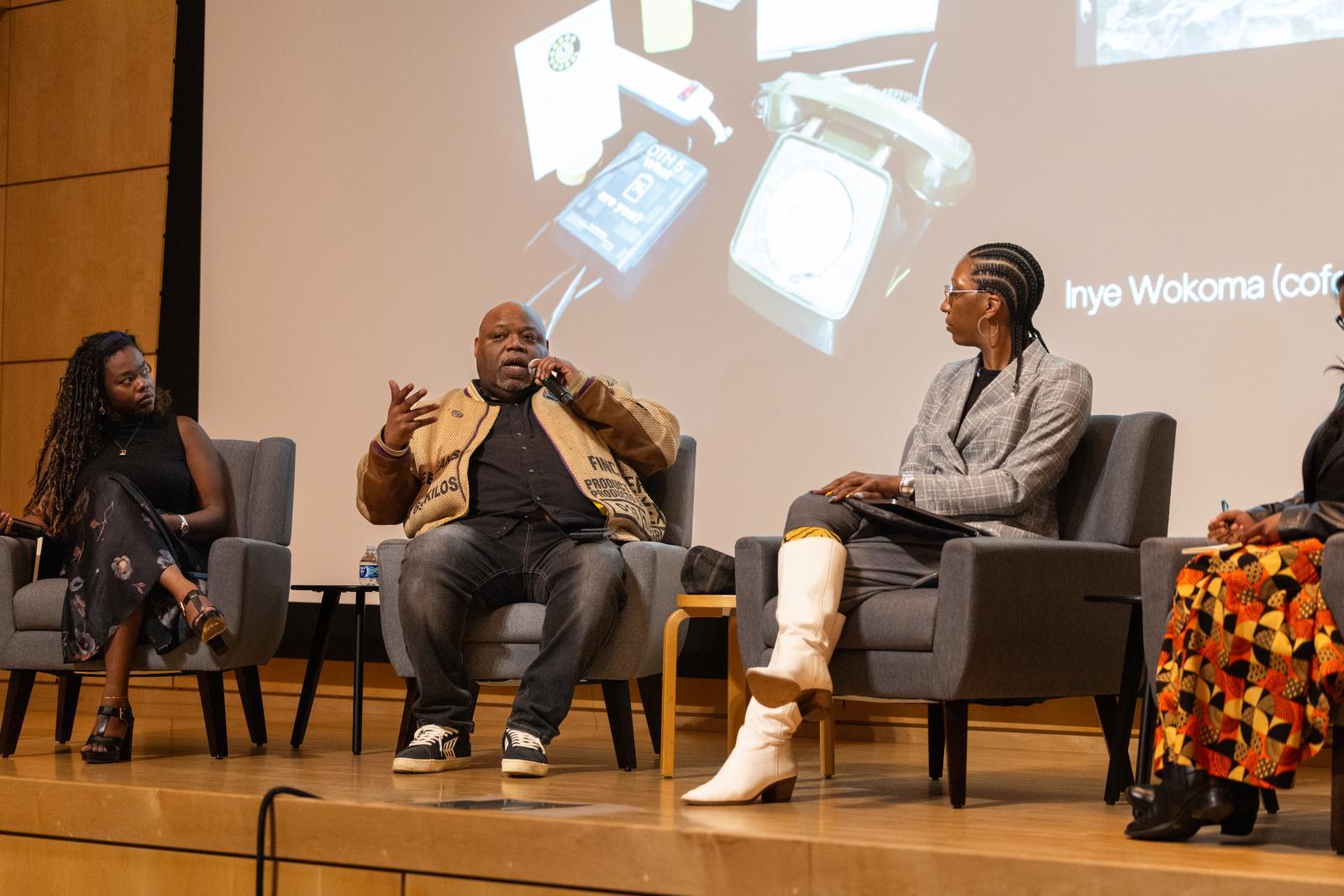
In mid-May, the UW team invited to campus other Black Digital Studies scholars and community organizers for a public panel and publication-focused workshop. The group included Rebecca Bayek (Utah State University), Simone Durham (Morgan State University), Christopher Paul Harris (UC Irvine), Brandy Monk-Payton (Fordham University), A.E. Stevenson (University of Chicago), and Inye Wokoma (Wa Na Wari, Seattle). Kwame Otu (Georgetown University) participated remotely.
The panel took place at the Henry Art Gallery and featured "lightning talks" about objects related to each speaker's work. Oloukoï explains that, by centering objects, “we wanted to really insist on the materiality of digital systems and the material impact that they have.” Some of the objects included a rotary telephone, a dog collar, a clipboard, and mangled copper wire extracted from e-waste in Ghana.
The lightning talks spoke to pressing, contemporary concerns related to surveillance of social media, algorithms’ suppression of activist posts, and the inability to distinguish real from fake online. The Black Digital Studies team seeks to place these concerns in the context of the much longer history of white supremacist practices and anti-racist resistance in the United States and elsewhere. Owens shared, “The relationship between Black people and technology and access and education. . . has always been under threat, and continues to be under threat in these digital spaces. . . It's just even more crucial to ensure that there is work [examining] these things.”
Participation in the panel by Wokoma, co-founder of the Seattle non-profit Wa Na Wari, connected the discussion to community organizations. Wa Na Wari formed in 2019 as part of efforts to resist gentrification in the historically Black Central District neighborhood. One of Wa Na Wari’s programs, the Seattle Black Spatial Histories Institute, focuses on preserving Seattle’s Black history and memory through oral history interviews and archiving. The Black Digital Studies team seeks to amplify such programs by working with regional Black newspapers and media outlets, like the South Seattle Emerald, through podcast opportunities and other press engagements.
The workshop, which took place at the Simpson Center the day after the panel, focused on presenting and discussing draft essays on three broad themes: Black memory workers and Black digital workers; surveillance, sousveillance (recordings by ordinary people rather than authorities), and social movements; and Black arts, culture, and technology. The essays will be submitted to SOULS: A Critical Journal of Black Politics, Culture, and Society which, unlike many academic journals, invites special issues that include non-peer reviewed multimedia content. SOULS, Oloukoï explains, “is an academic journal but it also looks like a magazine online.” Owens agreed, “We want to go outside of the ivory tower to the extent that we can. . . It is really important to ensure that we have work that is accessible . . . and interesting to a lot of different people.”
Owens and Oloukoï note that, today, one cannot really escape either technology or race, especially Blackness. On one hand, this project delves into the punitive practices of surveillance, extraction, and harassment that have long been tested out on Black people and others and are now more widely prevalent. On the other, it explores how the same people have resisted those practices. From their collective research, the team has learned that Black resistance can teach us to question dominant narratives and to avoid binary analyses of the relationships between Black people and technology.
During the workshop, Owens recognized a common interest among participants in exploring contradictions in the relationship between Black people and digital spaces, and a shared desire to think about both the promise and pitfalls of these technologies. Wokoma’s description of Wa Na Wari’s initiatives demonstrated the power that digital platforms can have for local outreach and connection within neighborhoods and across cities. Black and other communities often must rely on these technologies without having control over the platforms. And still, during the lightning talks, panelists emphasized that in-person relations are vital for building social movements, no matter how dominant new technologies become.